
If you have engineered wood flooring at home, you’ve likely asked yourself: Can you sand engineered wood floors, or are you stuck replacing the whole thing when scratches show up?
The short answer is YES, but it highly depends on the wear layer thickness.
Before you spend thousands of dollars on a full floor replacement (and deal with the headache of tearing up your home), floor restoration is almost always worth exploring first.
In this guide, we’ll break down when engineered wood can be restored, how to check if your floors are suitable, and share a real-life restoration project where we brought scratched floors back to life.
When can you sand engineered wood floors?
Unlike traditional solid hardwood, engineered wood consists of a natural wood veneer top layer (the wear layer) bonded over a plywood or composite core.
Whether or not your floor can handle heavy sanding comes down to the thickness of that top wear layer (what is wear layer?):
| Wear Layer Thickness | Refinishing / Sanding Potential | Recommended Restoration Method |
| Less than 2 mm | Do NOT sand. You will cut through into the plywood core. | Spot refinishing, screen & recoat, buffing & polishing |
| 2 mm – 3 mm | Can handle 1 light sanding | Deep buffing or light orbital sanding |
| 4 mm – 6 mm+ | Can be sanded 2 to 3 times professionally | Full sand and refinish |
Pro Tip: The only way to confirm your floor’s exact wear layer thickness is to inspect a cross-section of an unused plank or check the manufacturer’s product specifications. If you are unable to verify the thickness, it is always safer to avoid full sanding.
Case study: Repair scratches on engineered wood floors
One of the most frequent questions we get from clients is: “Can I repair scratches on my engineered wood floor?” The answer is YES – especially for surface scratches, scuffs, and protective coating wear.
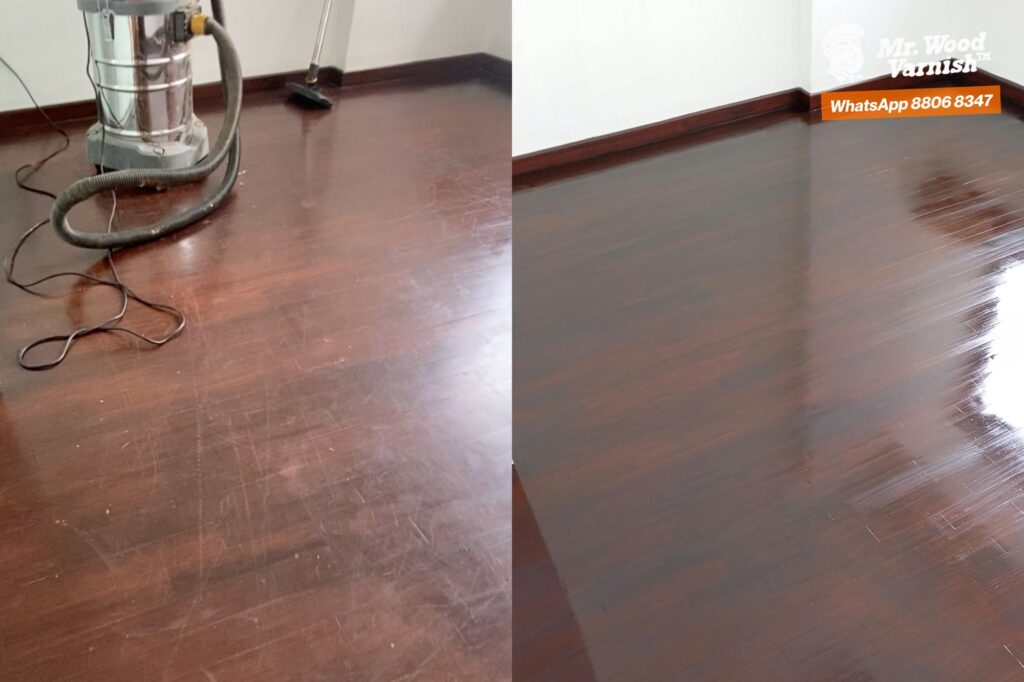
Here’s a real-world restoration project where we repair scratches on our client’s engineered wood floors without a full sand down.
The Problem
Our client had noticeable scratches across their engineered wood floor from daily wear and furniture movement.
Our Solution
Instead of taking an aggressive drum sander to a delicate wear layer, we executed a targeted, minimal dust restoration process:
- Spot Refinishing: Targeted treatment directly on the heavily scratched areas.
- Light Polish: Prepared the entire floor surface to repair fine scratches, and restore smoothness.
- Stain & Varnish: Finished with a rich walnut stain and a premium varnish topcoat for an even uniform finish
This was a 1 day job, and floors were ready for usage the next day.
The Result
Over 90% of the visible scratches were completely gone. The floor was restored to an almost like-new appearance, saving the homeowner the cost, headaches, and long downtime of a full flooring replacement.
How to tell if your scratched floor can be fixed
Because engineered wood varies in thickness and finish, custom restoration is usually required. The easiest way to find out if your floor can be saved is to send us a few photos, and our team will give you an honest expert evaluation.
Want to do a quick check right now? Look for these three signs:
- Depth: Run your fingernail across the scratch. If it barely catches, the damage is strictly in the clear varnish layer and can be polished away.
- Color: If the scratch matches the surrounding wood, it’s superficial. If it looks raw, dark, or grey, moisture or dirt has reached bare wood, requiring a fresh stain and sealer.
- Sanding History: If your floor was sanded down in previous years, the wear layer might be too thin for heavy sanding, making low-impact spot refinishing your best option
Get a free inspection from our experts!
We’re your one-stop solution to all your home improvement needs. Get us to help: Parquet sanding & varnish, Engineered wood polishing, Parquet repair, Outdoor deck varnishing, Marble polishing, marble gum grouting, homogenous tile polishing, and epoxy grouting.